
William Kentridge South African, b. b.1955

William Kentridge (b. 1955) is one of South Africa’s most internationally recognised contemporary artists, whose work spans drawing, printmaking, animation, sculpture, theatre and opera.
Although his practice had been influential in South Africa since the late 1970s, he first gained widespread international critical attention in 1997, when he participated in Documenta X in Kassel, Germany, as well as the Johannesburg and Havana Biennials. A retrospective of his films and drawings toured European museums in 1997–98. His work has since been exhibited at major international institutions, including the Museum of Modern Art in New York, the Louvre in Paris and the Royal Academy of Arts in London.
Born in Johannesburg to prominent anti-apartheid lawyers Sydney and Felicia Kentridge, he grew up within a politically engaged environment during apartheid. Kentridge studied Politics and African Studies at the University of the Witwatersrand, graduating in 1976, while pursuing his artistic training under Bill Ainslie at the Johannesburg Art Foundation.
An important early influence was Dumile Feni, whose expressive charcoal drawings demonstrated to Kentridge the power of large-scale figurative drawing. During the late 1970s he worked extensively with the Junction Avenue Theatre Company and the Market Theatre as an actor, director, set designer and poster-maker. His first solo exhibition was held at the Market Gallery in 1979, followed by Domestic Scenes in 1981, before he left for Paris to study theatre at Jacques Lecoq.
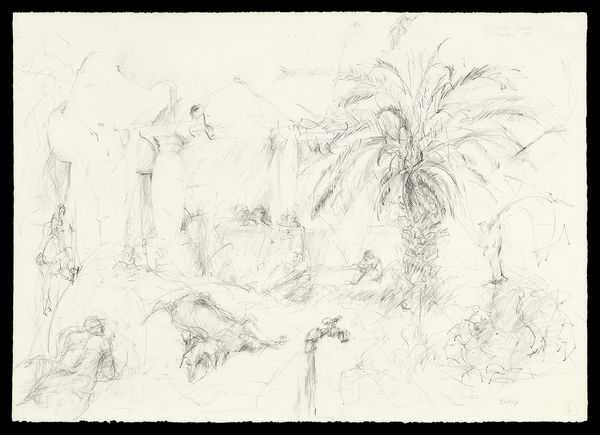
Drawing remains central to Kentridge’s practice, particularly his use of charcoal, whose capacity for erasure, revision and reworking became fundamental to his animated films. His interdisciplinary approach draws upon his early involvement in theatre, where performance, collaboration and the construction of images inform one another. Although deeply concerned with the political and social realities of apartheid South Africa, Kentridge has resisted direct political illustration, favouring ambiguity, contradiction and uncertain endings. His work interrogates the relationship between personal and collective memory, the construction of history and the ways in which political power enters ordinary human experience.

William Kentridge is a South African artist whose practice encompasses drawing, printmaking, animation, sculpture, theatre and opera. Born in Johannesburg, where he continues to live and work, Kentridge has developed a distinctive interdisciplinary approach in which drawing remains central.
His work moves between the personal and the political, engaging with South African history while addressing broader questions of memory, power and the relationship between individual and collective experience.
Kentridge grew up in a politically engaged family during apartheid. His parents, Sydney and Felicia Kentridge, were prominent anti-apartheid lawyers; his father represented the family of Steve Biko, while his mother helped establish the Legal Resources Centre in 1979. His artistic education began early, through evening classes at the Johannesburg Art Foundation, established by Bill Ainslie. There, Kentridge encountered the work of Dumile Feni, whose expressive, large-scale charcoal drawings made a lasting impression on his understanding of what drawing could communicate.
Although he initially pursued fine-art studies at the University of the Witwatersrand, Kentridge moved towards Politics and African Studies, completing his degree in 1976. His dissatisfaction with certain developments in contemporary European and American art was closely connected to the political circumstances of South Africa. Abstraction appeared to him, at the time, insufficiently engaged with the world around him, while conceptual art seemed removed from the urgency of the country's social and political struggles. He was more receptive to the theatrical experimentation of Dada and to artistic practices that could accommodate contradiction, absurdity and the instability of meaning.
Throughout the late 1970s and early 1980s, Kentridge worked across several disciplines without committing himself entirely to any one of them.
He trained under Ainslie, taught etching at the Johannesburg Art Foundation, made prints and short 8-mm animations, and became closely involved with the Junction Avenue Theatre Company and the Market Theatre. His work as an actor, director, set designer and poster-maker developed alongside his graphic practice. His first solo exhibition, held at the Market Gallery in 1979, included the Pit monoprints, whose enclosed, stage-like spaces and ambiguous relationships between performers and spectators suggested an early interest in the theatrical organisation of human experience. In February 1981, he exhibited Domestic Scenes, before leaving Johannesburg to study at Jacques Lecoq in Paris.
These early years were marked by considerable experimentation and uncertainty. At twenty-five, Kentridge had rejected the expected family path into law but had not yet established what direction his professional future would take. His work moved between the studio and the stage, between individually produced drawings and the collaborative demands of theatrical performance. Rather than developing as separate disciplines, these activities increasingly informed one another.
The political circumstances surrounding this early work were equally significant. In the years following the Soweto uprising and Steve Biko's death, the apartheid state intensified its use of detention, censorship and political suppression. Kentridge's involvement with the Market Theatre and Junction Avenue placed him within an experimental theatrical culture concerned with racism, exploitation and social injustice. Yet his artistic response was rarely one of direct illustration. Instead, Kentridge became interested in the ways that history and power could be registered indirectly, through ordinary objects, domestic interiors, theatrical situations and gestures whose meanings remained unresolved.
Drawing became the foundation of this approach.
Although his earliest exhibitions were dominated by monoprints, etchings, pencil drawings and works made with black floor polish, charcoal would become particularly important to his mature practice. Its immediacy and capacity for alteration offered possibilities distinct from those he associated with painting. A drawn image could be revised, erased and reworked, allowing the process of making to remain visible within the finished work. This openness to change became central to his animated films, in which successive alterations to charcoal drawings produce movement while retaining the material traces of earlier states.
Kentridge's work in other media has continued to develop from this graphic foundation. Drawn lines enter theatrical productions and filmed projections, scenes from performances reappear in works on paper, sculptural objects translate drawn forms into three-dimensional space. His practice repeatedly tests the relationship between image and object, between the temporary gesture and the more enduring form.
Kentridge's international recognition expanded significantly in 1997, when he participated in Documenta X in Kassel, Germany, as well as the Johannesburg and Havana Biennials. A retrospective of his films and drawings toured European museums in 1997–98, introducing wider audiences to a practice that had already been influential in South Africa for more than fifteen years. His subsequent international exhibitions and acclaimed work in theatre and opera established him as an important figure in interdisciplinary contemporary art.
Although Kentridge's work is inseparable from the historical circumstances of South Africa, its significance does not depend upon direct political illustration. His drawings, films and performances consider how history is experienced and remembered, how authority is constructed, and how private life remains entangled with broader social conditions. The recurring movement between drawing and erasure, construction and revision, offers no simple resolution to these questions. Instead, Kentridge's practice allows uncertainty and contradiction to remain active, treating the making of an image as a process through which the past can be revisited without necessarily being settled.




![William Kentridge, Tear & Repair 2 - Design Indaba, poster [2], 2015](https://static-assets.artlogic.net/w_600,c_limit,f_auto,fl_lossy,q_auto/artlogicstorage/peffersfineart/images/view/e2c3084d3a4bb993d4e6fff0b3b7f6c9j/peffersfineart-william-kentridge-tear-repair-2-design-indaba-poster-2-2015.jpg)

![William Kentridge, The Magic Flute poster [1], 2007](https://static-assets.artlogic.net/w_600,c_limit,f_auto,fl_lossy,q_auto/artlogicstorage/peffersfineart/images/view/2ad70d44aa203d4bdc1a7219f4807fd7j/peffersfineart-william-kentridge-the-magic-flute-poster-1-2007.jpg)

![William Kentridge, What Will Come, Goodman Gallery exhibition poster [1], 2007](https://static-assets.artlogic.net/w_600,c_limit,f_auto,fl_lossy,q_auto/artlogicstorage/peffersfineart/images/view/2f45af0e55ba9c669b2737c036e8d939j/peffersfineart-william-kentridge-what-will-come-goodman-gallery-exhibition-poster-1-2007.jpg)

![William Kentridge, William Kentridge, Goodman Gallery, Johannesburg, October 1999, exhibition poster [1], 1999](https://static-assets.artlogic.net/w_600,c_limit,f_auto,fl_lossy,q_auto/artlogicstorage/peffersfineart/images/view/508305d47abf04d0075a56a420986b98j/peffersfineart-william-kentridge-william-kentridge-goodman-gallery-johannesburg-october-1999-exhibition-poster-1-1999.jpg)
