What do we learn to live with?
Hedonic Adaptation: Structures of Survival and Repair brings
Edoardo Villa's welded steel sculptures into dialogue with
Tshepo Sizwe Phokojoe's hessian constructions. The encounter
is immediate - weight against fibre, monument against shelter,
the welded join beside the sewn seam - but its deeper subject
is the human capacity to adapt.
Some forms of adaptation keep us alive. Others make the
intolerable feel ordinary. Responding to HEAT 2026's theme,
Ctrl + Z, the exhibition begins from the recognition that history
has no undo command. Damage cannot be made not to have
happened. Yet inherited forms can be looked at again. They can
be unsettled, re-read, softened, re-skinned and held differently.
-
-
What materials remember
Steel remembers the furnace. Hessian remembers the hand.What have we learned to accept, what still needs our attention, and what might we learn to hold differently?
Edoardo Villa and Tshepo Sizwe Phokojoe are separated by generation, biography and material language. Their histories should not be collapsed into one another. Yet both artists begin from matter that has already been asked to carry weight, and both transform it into a structure through which a human life can be felt.
Villa's life in South Africa began with rupture. Born near Bergamo in 1915 and trained in sculpture, he was conscripted during the Second World War, wounded in North Africa, captured and sent to the Zonderwater prisoner-of-war camp east of
Pretoria. After his release in 1947, he chose to remain in South Africa. His early Johannesburg years were marked by poverty, uncertainty and experiment. Over time, cut and welded steel became the material through which he built both a sculptural language and a place for himself.
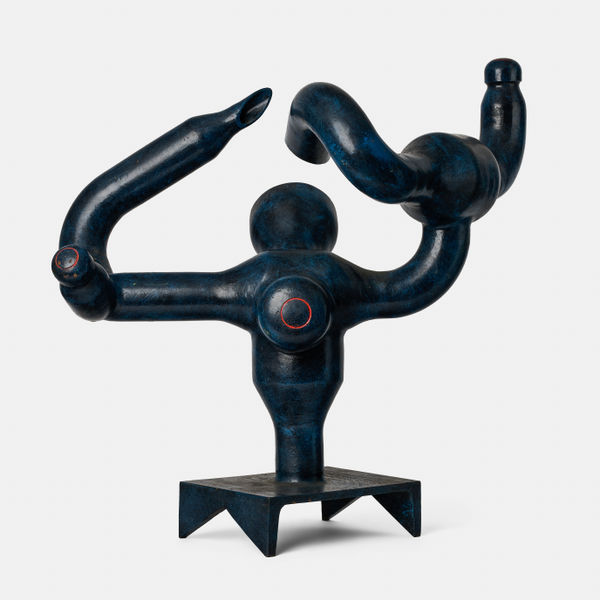
The apparent certainty of Villa's sculpture can make this beginning easy to forget. His works stand upright. They compress mass, suspend weight and command space. Yet steel does not arrive in these forms untouched. It is cut, heated, forced, joined and balanced. The authority of the finished object is produced through pressure. Beneath its monumentality lies a material record of change.
Phokojoe's work begins from a different history of movement and belonging. Raised in Soweto, he uses hessian not as a neutral support but as a material with social memory. Sackcloth has carried goods across distance; it has been handled,
reused and made to bear loads. In accounts that inform his practice, it also recalls the Sakman community and the improvised hessian shelters of Masakeng, established through James "Sofasonke" Mpanza's mobilisation of displaced people. The material is therefore both surface and archive: a record of migration, settlement, precarity and the work of making home.
Hessian also enters Phokojoe's practice through intimacy. His first encounter with manipulating cloth came through his mother. In his hands, stitching is never merely decorative. It binds, gathers and repairs, but it also puckers, exposes and refuses a perfect finish. Knotted forms accumulate like nests, organs, bundles or memories. Threads remain loose. The work moves beyond its frame as though
home were something that had to be made repeatedly and could never be fully contained.
The dialogue between Villa and Phokojoe is therefore not simply hard against soft, old against new, or modernist against contemporary. Steel can be wounded. Cloth can bear extraordinary weight. Villa's sculpture turns industrial material toward the human body; Phokojoe turns a humble transport textile toward shelter, ancestry and the unsettled question of belonging.
A welded seam and a sewn seam are both decisions about what must hold. This is where the title Hedonic Adaptation becomes urgent. The term describes the tendency to become accustomed to changed circumstances. That capacity can be a form of resilience, but it can also normalise harm. Societies adapt to inequality, inherited authority, damaged environments and unresolved histories. The structures remain, while our attention to them fades.
The works in this exhibition interrupt that fading. Villa's balances make pressure visible. Phokojoe's frayed edges keep the labour of holding visible. Neither artist offers repair as erasure. Instead, they give form to endurance: not the fantasy of returning to an untouched past, but the harder task of recognising what has happened and building from where we stand.
For the collector, this dialogue offers more than a meeting of two significant practices. It brings a foundational figure of South African modernist sculpture into a living conversation with an artist extending the language of material, home and migration in the present. To live with one of these works is to live with a question: what have we learned to accept, what still needs our attention, and what might we
learn to hold differently?
-
Curatorial Statement
In the real world, there is no simple command for undoing the legacies of racism, patriarchy, extractive economies, ecological destruction, or the psychological and material consequences of historical violence.
Hedonic Adaptation: Structures of Survival and Repair brings together a focused selection of Edoardo Villa’s 1990s steel sculptures from the holdings of the last gallery that represented Villa in his lifetime – Friedland Art Inc. – into dialogue with works by contemporary South African artist Tshepo Sizwe Phokojoe.
The exhibition takes its title from the psychological concept of hedonic adaptation: the tendency of individuals and societies to become habituated to changed circumstances, including conditions of discomfort, instability or harm. Within the context of HEAT 2026’s theme, Ctrl + Z, the exhibition interrogates what happens when structures of damage become normalised, and whether art can interrupt this process through slow looking, material attention and acts of repair.
Rather than treating undoing as a simple reversal, the exhibition considers repair as a complex and ongoing negotiation with inherited forms. Villa’s steel sculptures speak in a language of weight, compression, balance, monumentality and modernist construction. Phokojoe’s work introduces a different material register: one associated with stitching, surface, vulnerability, shelter, memory, re-use, survival and care. Together, the works stage a dialogue between monument and shelter, steel and textile, inherited structure and lived repair.
The exhibition proposes that survival itself has structures. These may be physical, social, psychological, material or historical. Some structures are imposed; others are made in response to pressure. Some offer shelter; others preserve damage. By placing Villa and Phokojoe in dialogue, Hedonic Adaptation asks how art might make visible the forms we have learned to live within, and how acts of attention, repair and re-looking might begin to unsettle them.
HEAT 2026’s theme, Ctrl + Z, foregrounds the tension between the ease of undoing in digital space and the far more complex realities of repair in lived social, political and environmental contexts. In the real world, there is no simple command for undoing the legacies of racism, patriarchy, extractive economies, ecological destruction, or the psychological and material consequences of historical violence. The desire to return, repair, undo or rewire remains urgent, but the process is slow, partial and often unresolved.
Hedonic Adaptation: Structures of Survival and Repair responds to this theme by shifting attention from the fantasy of reversal to the condition of adaptation. What happens when societies become accustomed to damage? What happens when inequality, precarity, environmental degradation, inherited monumentality or structural violence become visually and psychologically normalised? How might art interrupt this adaptation, not by pretending to undo history, but by making its forms newly visible?
Edoardo Villa’s steel sculptures offer one point of entry into these questions. His works are often defined by their formal authority: welded steel, compressed mass, uprightness, balance, industrial material, and a powerful sense of sculptural presence. They are objects of poise and control, but also of pressure. Steel is forced into form. Weight is held in suspension. Industrial material is transformed into an aesthetic language of monumentality and structure.
In this exhibition, Villa’s work is not presented simply as historical modernism, nor as a closed chapter in South African art history. It is approached as an inherited language: one that carries beauty, ambition, authority and contradiction. His sculptures become forms through which to consider modernity’s claims to permanence, order and control, as well as the ways these claims are later re-read from the vantage point of the present.
Tshepo Sizwe Phokojoe’s practice offers a compelling counter-language. His work is materially and conceptually attuned to repair, memory, vulnerability and reconstitution. Through cloth, stitching, found or humble materials, and a sensitivity to home, shelter and survival, Phokojoe’s work opens another understanding of structure: not the hard structure of monumentality, but the adaptive structure of endurance. His works suggest that repair is not merely symbolic. It is material, bodily, intimate and ongoing.
The exhibition is therefore not conceived as a simple contrast between hard and soft, old and new, steel and textile, or modernist and contemporary. Rather, it is a conversation about how forms survive, how histories settle into objects, and how material practices can either naturalise or interrupt inherited structures.